
Montmorency County Sex Offender Checks
The Michigan Public Sex Offender Registry, or PSOR, is the first official channel for a Montmorency County registry search. Michigan State Police manages the service. A person can search by name or identifying number, choose Montmorency County, or use address and radius controls. The result is the public part of the state law-enforcement registry. It is not a list kept by the county and it does not include every person whose past conduct might concern a reader.
Use the Montmorency County Sheriff when the issue is local compliance or a possible factual location error. The office is at 11045 M-32 West in Atlanta and can be reached at 989-785-4238. The sheriff does not publish separate registration-counter hours, so call before going. For a conviction document, move from the profile to the court of conviction. The broader Montmorency County court case lookup explains how District and Circuit files divide.
Montmorency Registry Radius Searches
Place searches matter in Montmorency County. Atlanta and Lewiston are unincorporated census-designated places, while Hillman is a village. A postal city may not match the government boundary a reader has in mind. PSOR lets a user select Montmorency County, search by city or ZIP code, or set an address radius of 0.25, 0.50, 1, 2, or 5 miles. A county search gives breadth. An address-radius search gives a closer view of a specific area.
The official MSP sex offender registry information page explains the search tools and their limits. Its neutral search interface is shown below. Start broad when an address could fall near a township line, then narrow the results with the map. Do not infer that a blank city result means there are no published registrants in the surrounding county.
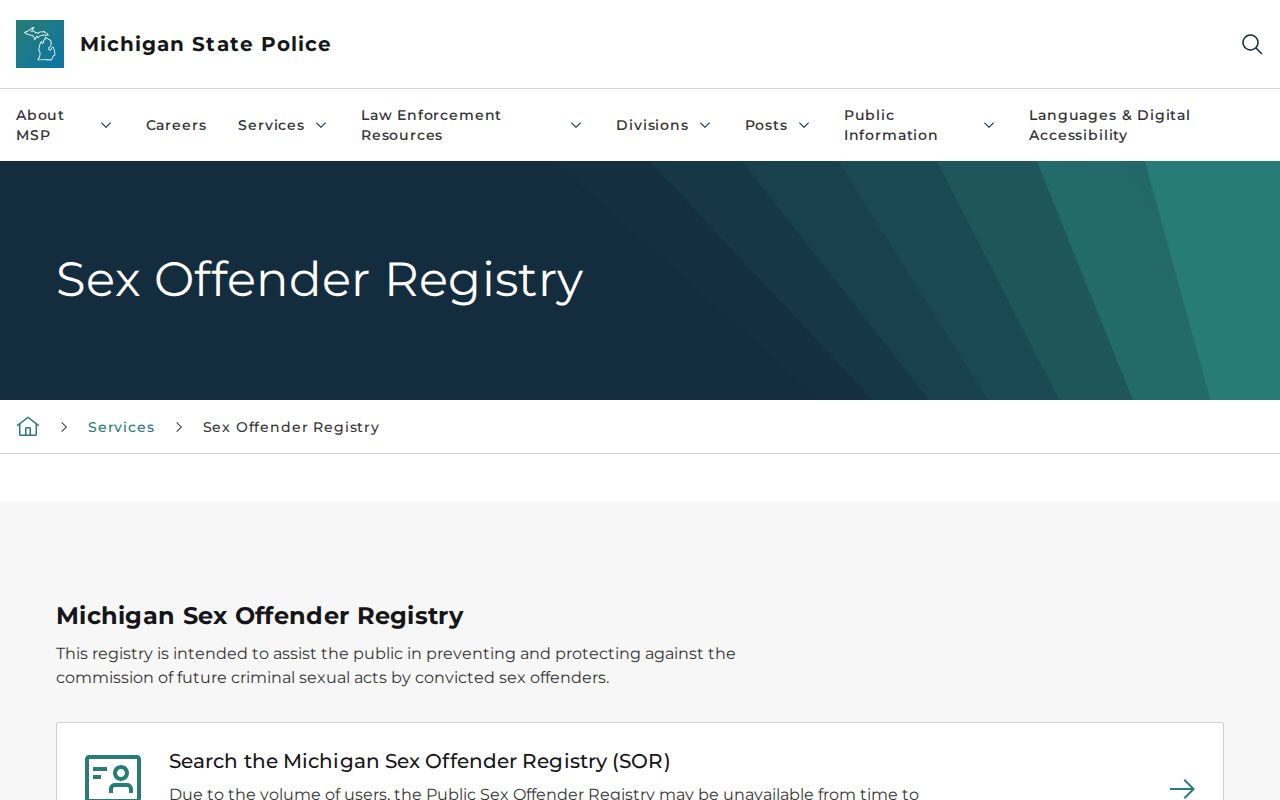
The MSP page is also the best place to confirm current definitions before relying on a Montmorency County registry status.
Michigan Public Sex Offender Registry Searches
The PSOR interface offers several paths. A name search requires both first and last name, and partial names are allowed. A registration number or MDOC number can serve as an alternate identifier. Geography fields support an address, city, county, ZIP code, and map radius. The portal also links to lists of all published, incarcerated, and non-compliant registrants. Those lists describe registry status, not guilt in a new event.
- Open PSOR and read the conditions that govern use of the public data.
- Choose a name or identifier search, or set Montmorency County and the needed place fields.
- Review the result list carefully and compare identifiers instead of relying on a name alone.
- Open “View Details” for the profile, status, offense, address, and tracking option.
| Field Label | Type | Required | Notes |
|---|---|---|---|
| First and Last Name | Text | For name search | Partial names are allowed |
| Registration or MDOC Number | Text | Alternative | Use a known identifier |
| Street Address | Text | Conditional | Add city, county, or ZIP |
| City, County, ZIP | Text or selector | No | Select Montmorency for a county search |
| Radius | Selector | For map search | 0.25 through 5 miles |
| Status Lists | Link | No | Published, incarcerated, or non-compliant |
The PSOR search screen captured for the project illustrates the statewide interface rather than any private person's entry.
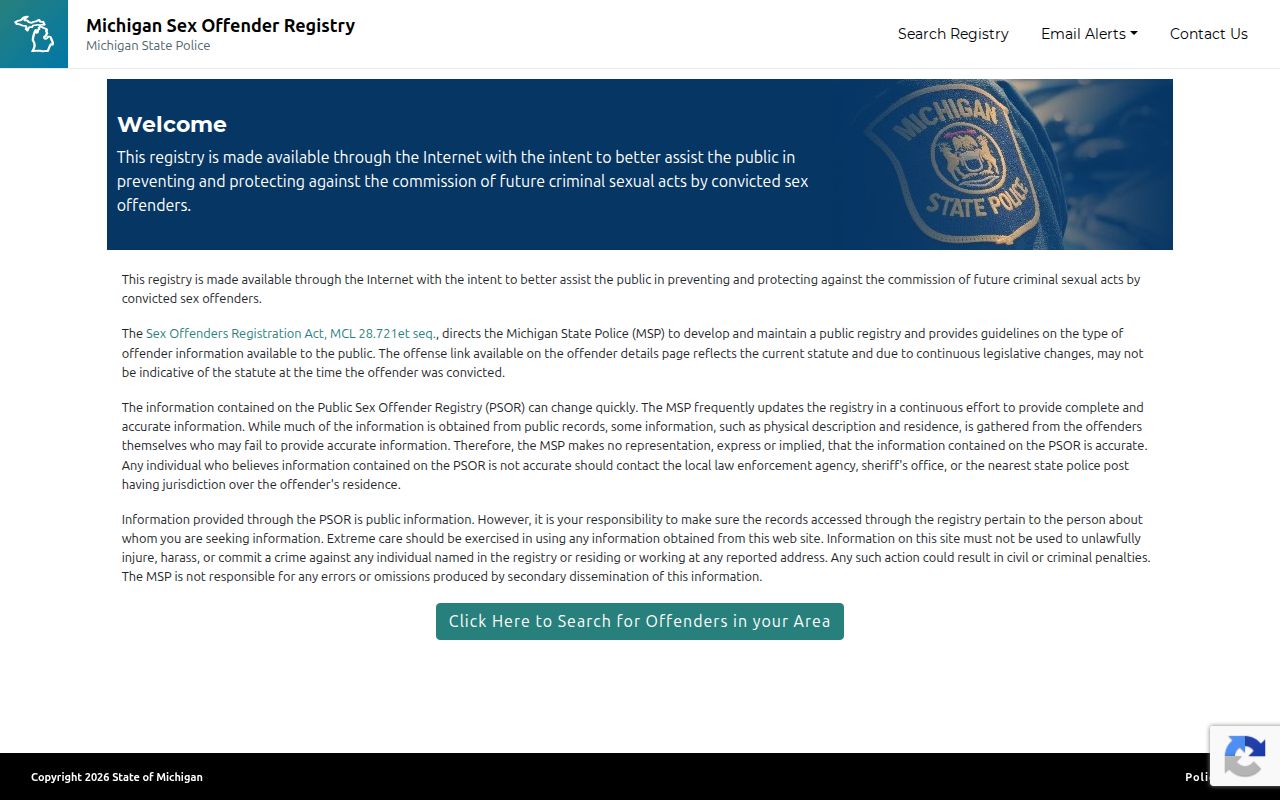
That distinction keeps the focus on how to search Montmorency County records, not on spotlighting an individual.
Track Montmorency Registry Updates
PSOR includes an email tracking tool for a published profile. Open “View Details,” select “Track Offender,” enter the same email address twice, accept the terms, and register. MSP says a confirmation should arrive within 24 hours. Once confirmed, the alert can report a move and changes in other listed registration information. This is a targeted update tied to one profile, not a complete alert for every address in Montmorency County.
Keep the first message until the subscription is active. If no confirmation arrives, check the address for a typo and review filtered mail. The tracking option can help with ongoing community awareness, but a user should still return to the live profile before acting on old email content. Registry facts can change, and the current PSOR page is the controlling public display.
Note: Michigan permits printing an individual PSOR page, but MSP does not make the full statewide list available as a download.
Registry Profiles: What They Show
A public profile combines identification, registration, and offense data. It may show a photo and physical descriptors, aliases, scars or tattoos, a registered address, campus information, vehicles, registration details, and the offense that led to registration. Status terms give important context. They do not independently say whether a person is under investigation or has committed a new offense.
| Name and Aliases | Published identity names and known variants |
|---|---|
| Photo and Description | Image, physical details, and listed marks or tattoos |
| Address Information | Public residence or other authorized location category |
| Offense Information | Listed offense and related conviction information |
| Campus and Vehicle Data | Published school, work, or vehicle information when authorized |
| Registration Status | Active, incarcerated, absconder, homeless, or another defined status |
Victim information is never a public profile field. When more context is needed, use the court of conviction for the official case documents rather than trying to reconstruct the case from the registry alone.
Missing Montmorency Registry Entries
A person may lawfully be absent from the public PSOR even when another record shows an offense. Reasons can include a juvenile adjudication, death, residence outside Michigan, an offense that is not listed, pre-1995 timing, a court-ordered removal, completion of the registration term, HYTA status, or a category that the public registry does not display. Heavy use can also make the public service unavailable for a time.
Do not turn a blank result into a broad claim. The public PSOR is only the published portion of the law-enforcement Sex Offender Registry. It is also separate from ICHAT, MiCOURT, and OTIS. Each system answers a different question. A set-aside can change public criminal-history access, but it does not automatically end every registration duty. Michigan law preserves registry treatment for some listed offenses even after a conviction is set aside.
Registration Levels and Duties in Michigan
Michigan uses three statutory tiers. The offense and its statute drive the tier; a reader cannot assign one based on a personal view of risk. Registration time does not include a period of incarceration for a crime or civil commitment. The exact reporting schedule and any reduction also depend on the statute and the person's legal status, so the table is a duration guide rather than a substitute for the official record.
| Tier | General Duration | Reporting Concept |
|---|---|---|
| Tier I | 15 years | Lower tier; reduction rules may apply |
| Tier II | 25 years | Intermediate statutory tier |
| Tier III | Life | Highest tier; most frequent reporting |
MCL 28.725 governs reporting frequency and duration. The statute image below records the official source used for the Montmorency County tier summary.
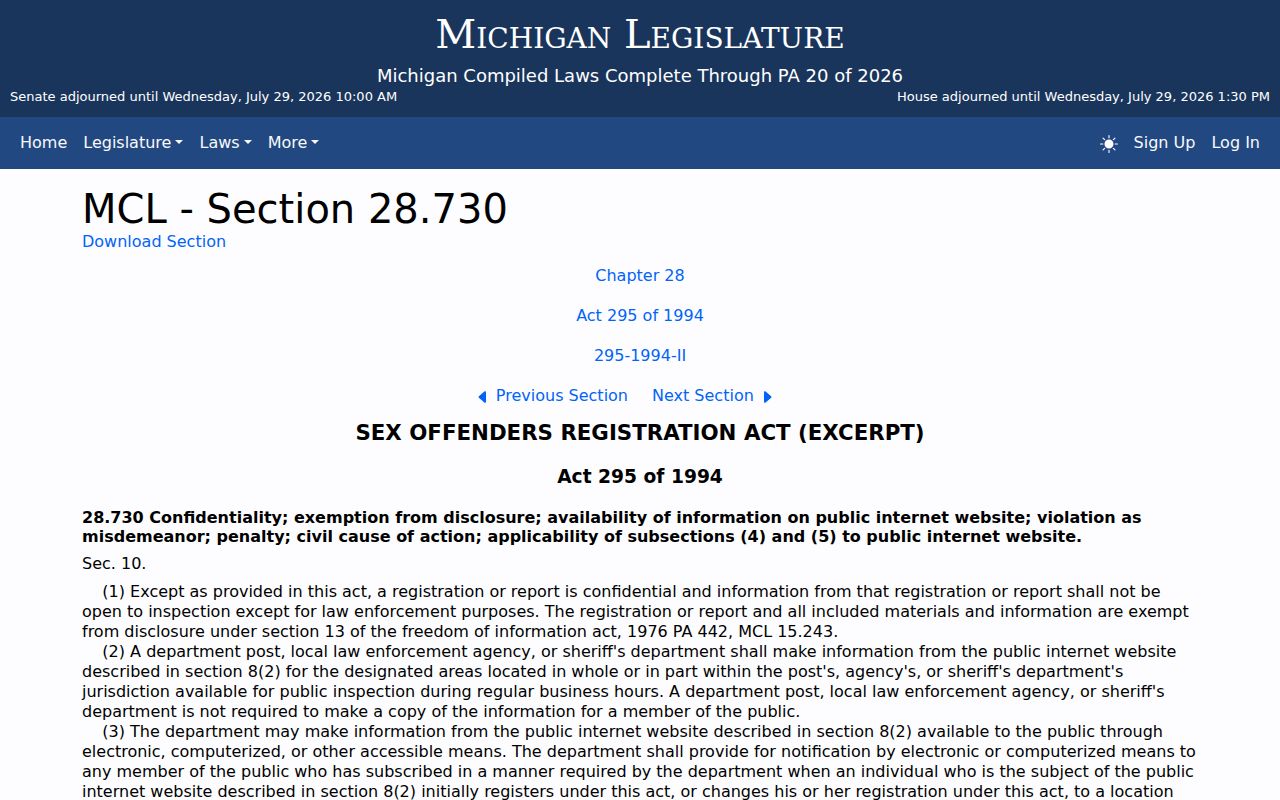
The statute, not the profile's plain-language label alone, controls the duty and term.
Montmorency Registry Status Terms
Status words need precise reading. “Active” means the registrant resides in Michigan. “Incarcerated” means current custody in Michigan. “Absconder” means the person's whereabouts are unknown from the last listed address, while “Homeless” means there is no fixed or temporary residence. “Pending Out of State” covers a planned move whose destination rules are not yet set. “Inactive Out of State” can describe someone who lives elsewhere but works or attends school in Michigan.
- School Only or Employment Only
- The person lives outside Michigan but has the listed Michigan connection.
- Non-Compliant
- The registry flags an issue with statutory duties; it is not a new conviction by itself.
- Submit a Tip
- The profile route for reporting a suspected factual error or violation.
For an urgent threat, use emergency channels. For a Montmorency County address or compliance question, contact the sheriff and state the factual concern without confrontation.
Montmorency PSOR and NSOPW
PSOR is the stronger tool for Michigan-specific fields, status language, radius controls, and profile tracking. The National Sex Offender Public Website adds a cross-state layer. It is useful when a person or address may connect to another state, but it does not replace Michigan's own profile details or the Montmorency County sheriff's local role.
| Question | Michigan PSOR | NSOPW |
|---|---|---|
| Montmorency County filter | Direct county and radius tools | Broader participating-jurisdiction search |
| Michigan status details | Primary public source | Links back to jurisdiction data |
| Cross-state check | Michigan focus | National search layer |
The NSOPW interface captured for this project shows the federal search entry point.
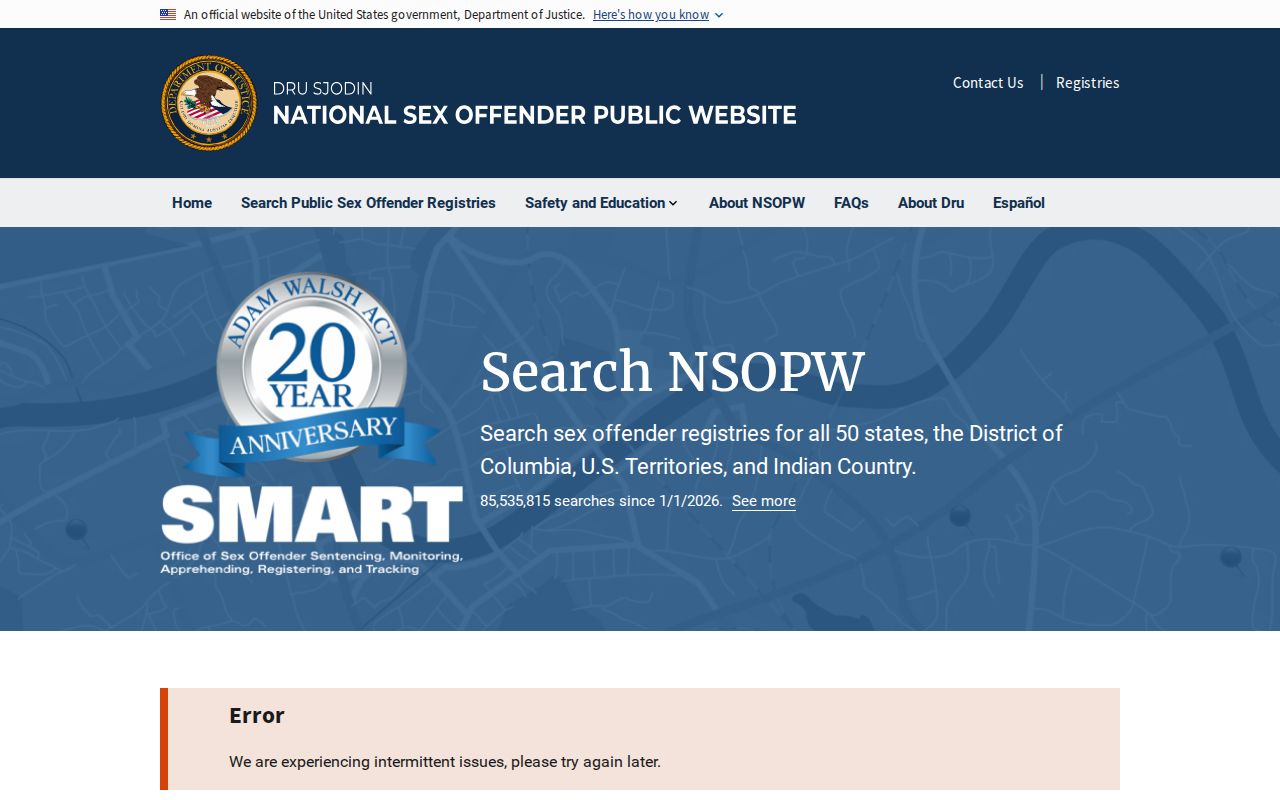
Use it when geography crosses state lines, then confirm the result on the source jurisdiction's registry.
Using Registry Information Lawfully
Registry data supports public safety and informed community awareness. It should be read in context and checked against the live source. A PSOR status is not a prediction of future conduct. A profile is not a substitute for a court judgment, and the public registry never releases victim information. If a displayed Montmorency County fact seems wrong, use “Submit a Tip” or contact the sheriff rather than publishing a claim or approaching the person.
No threats or vigilantism: MCL 28.730 prohibits using Michigan registry information to threaten, intimidate, or harass a registrant or household.
The safest practice is simple. Use the registry for awareness, respect the limits of the public data, and send a suspected compliance issue to the officials who can verify it.