
Criminal Court Cases in Montmorency County
Montmorency County criminal court cases begin in the 88th District Court. That court resolves misdemeanors with a maximum jail term of no more than one year. It also handles felony arraignments, probable-cause conferences, preliminary examinations, and pleas before bindover. A misdemeanor therefore stays on one district docket. A felony may acquire a second case record after the district judge sends it to the 26th Circuit Court.
The 26th Circuit Court hears the felony plea, trial, and sentence after bindover. The County Clerk serves as clerk of that court and keeps its filings. This split matters. A search of only one Montmorency County court can miss half of a felony's path, while a district misdemeanor will not move to a circuit criminal docket at all.
The official District Court source shows the local court's role and contact details.
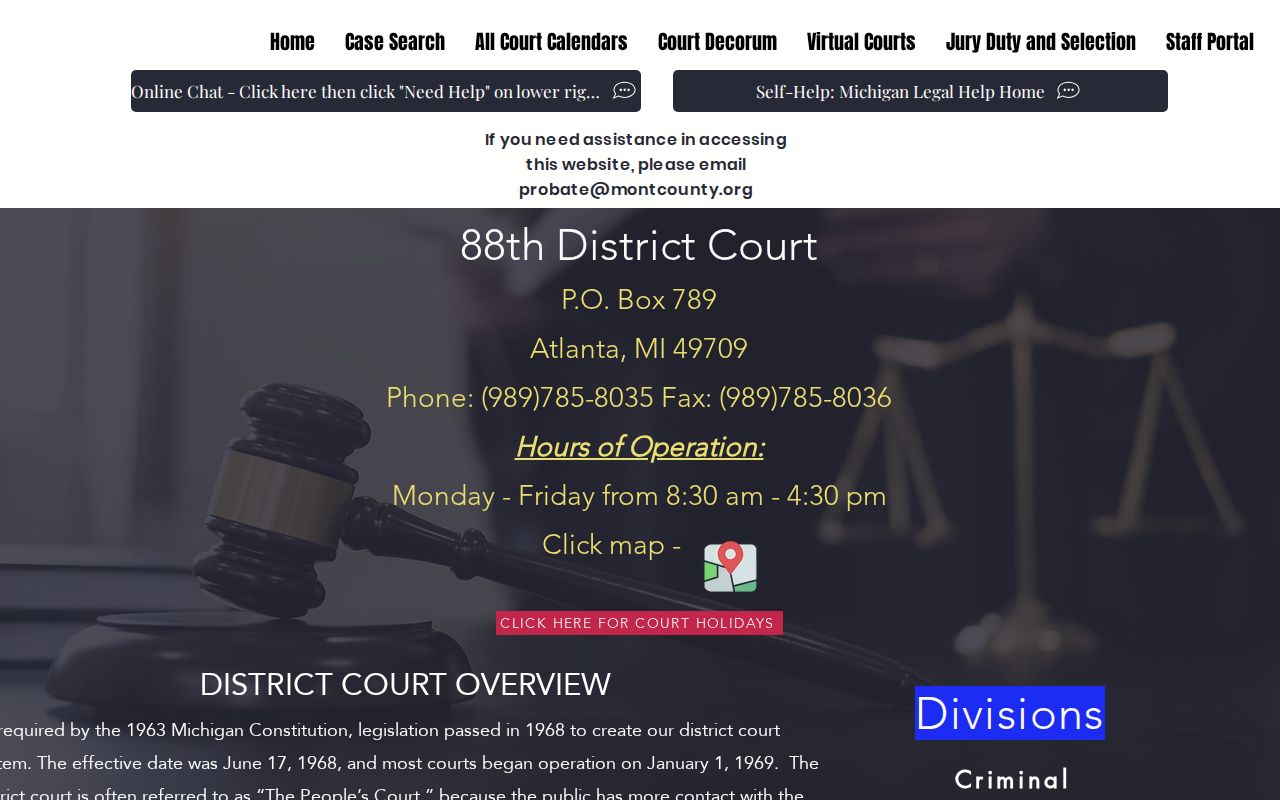
Use that court for misdemeanor files and the first phase of a felony case.
Montmorency Felonies Change Courts
A felony does not start in Circuit Court. The complaint and first arraignment appear in the 88th District Court, where the judge addresses the charge and bond. The district phase can also include a probable-cause conference and preliminary examination. If probable cause is found or the examination is waived, the case is bound over. The prosecutor then files an information in Circuit Court, and the circuit phase receives its own record.
This is the local trap most likely to produce an incomplete result. Search the district court first, even when the alleged offense is a felony. Then search the 26th Circuit Court for a later file. Match the person, charge, dates, and bindover entries instead of assuming that similar names refer to the same matter. For an official link between the two files, ask the clerk for the register of actions and charging document.
Note: A bindover transfers the felony for further proceedings; it does not decide guilt or guarantee that the original charge remains unchanged.
Montmorency County Case Record Searches
MiCOURT Case Search is the free online starting point for Montmorency County case records. Its data is informational, not the official court file. Choose the precise court because the same felony may have district and circuit phases. A full case number gives the cleanest match. A participant-name search is useful when the number is unknown, but date of birth and case type may help separate similar names where those filters appear.
- Open MiCOURT, accept its terms, and select the 88th District Court for misdemeanors or early felony proceedings.
- Choose case number or party name as the search type, then enter the strongest known identifier.
- Review the filing date, status, charge, statute, and event history. Do not treat the first listed count as the final disposition.
- Repeat the search in the 26th Circuit Court when the district docket shows a felony bindover.
- Contact the correct clerk for the official register of actions, charging paper, judgment, sentence, or certified copy.
| Field Label | Type | Required | Options or Notes |
|---|---|---|---|
| Court | Selector | Yes | Select 88th District or 26th Circuit for Montmorency County |
| Search Type | Tab or radio | Yes | Case Number or Party Name |
| Case Number | Text | Conditional | Use the court's full number when known |
| Last Name or Business Name | Text | Conditional | Primary party-name field |
| First Name | Text | Optional | Narrows a person match |
| Date of Birth | Date | Optional | Shown where the selected court exposes it |
| Case Type | Filter | Optional | Availability depends on the court |
| Search | Button | Yes | Runs the selected query |
Montmorency Court Files at Two Counters
Online entries help locate a file, but the clerk supplies the authoritative record. The 88th District Court counter is at 12265 M-32 in Atlanta, with mail directed to P.O. Box 789. Its main number is 989-785-8035. Ask that office about misdemeanor judgments, felony complaints, arraignments, preliminary examinations, and the district register of actions. Published hours are 8:30 a.m. to 4:30 p.m. on weekdays.
For a felony after bindover, contact the County Clerk at 989-785-8022 for the 26th Circuit Court file. Circuit scheduling is handled through 989-354-9573. State the exact document needed, such as the information, judgment of sentence, or certified register of actions. The local pages do not publish a fixed copy or certification fee, so confirm the amount and an accepted mail method before sending payment or traveling.
The official Circuit Court page identifies the Montmorency County clerk's record role.
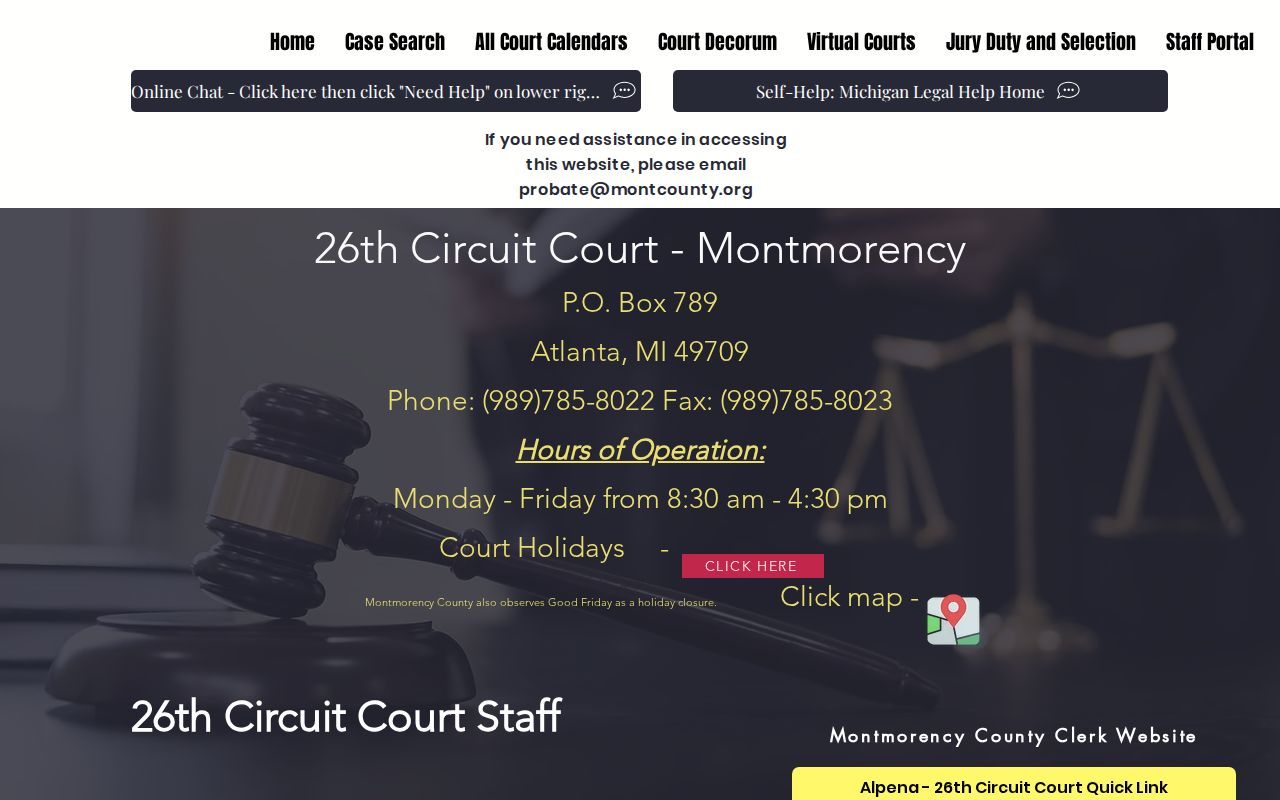
That office is the correct source for certified felony documents created after bindover.
What a Criminal Case File Contains
A Montmorency County court case file is a set of judicial records, not one summary sheet. MiCOURT can reveal core docket data, while the clerk may hold the filed documents behind those entries. Request the part that answers the question. The charging paper identifies allegations; the register of actions gives the timeline; and the judgment and sentence state the adjudicated result. A docket label alone may not explain why a count changed.
| Case Number & Court | Identifies the tribunal and file; a felony may have both district and circuit numbers. |
|---|---|
| Charging Document | The complaint begins the district case, while an information commonly states the post-bindover felony counts. |
| Docket Entries | The register of actions lists filings, hearings, rulings, pleas, and other events in date order. |
| Hearing Dates | Shows scheduled or completed court events, subject to later changes by the court. |
| Disposition & Judgment | States how each count ended, including dismissal, acquittal, plea, or verdict. |
| Sentence & Conditions | Records public sanctions after conviction, which may include custody, probation, fines, or restitution. |
Financial fields may also appear online, but the clerk should confirm a current certified balance. Docket metadata does not mean every underlying document can be downloaded. Audio or a transcript may require a separate request, and availability depends on what was created and retained.
Reading Montmorency Case Dispositions
Read the result count by count. “Pending” means that the court has not resolved that count. “Dismissed” means it ended without a conviction, though the precise order controls whether further action is possible. “Acquitted” follows a not-guilty verdict. “Convicted” means guilt was established by plea or verdict, but the actual offense and sentence may differ from the first charge shown after arrest.
- Register of actions
- The court's chronological docket of filings and events.
- Complaint
- The initial sworn charging document used in District Court.
- Information
- The prosecutor's felony charging document after bindover or waiver.
- Disposition
- The way a charge ended, which must be read for each count.
- Set aside
- Michigan's process for making an eligible conviction nonpublic, subject to statutory exceptions.
MiCOURT also warns that the displayed charge level for some attempts under MCL 750.92 can temporarily read as a felony even when the attempt is legally a misdemeanor. Check the cited statute and ask the clerk when that label affects the meaning of a Montmorency County criminal case record.
Criminal Case Stages in Montmorency County
The court record grows as each stage occurs. A complaint follows the investigation and charging decision. At arraignment, the court states the charge and addresses plea and bond. A Montmorency County felony may then have a probable-cause conference and preliminary examination in District Court. Bindover moves it to Circuit Court for an information, circuit arraignment, motions, pretrial work, plea or trial, and sentence. A misdemeanor normally completes its whole path in District Court.
Case flow: Charges Filed › Arraignment › Pretrial › Plea or Trial › Disposition › Sentencing
The register of actions is the best map of that sequence. Dates can shift, and an online status may lag a signed order. If a result matters, obtain the disposition or judgment from the clerk rather than inferring it from a hearing label. The contextual Montmorency County arrest search can explain the earlier report and booking records, but the court file controls the filed charge and outcome.
Missing Montmorency Court Case Records
An absent MiCOURT result does not prove that no case exists. The portal excludes juvenile, child-protective, personal-protection, mental-illness, and other protected matters. Some courts also apply a seven-year criminal-sentence display filter. Older archives, spelling differences, suppression, a recent filing lag, or selection of the wrong Montmorency County court can also explain a blank search.
Repeat the search with the case number when possible and check both trial courts for a felony. Then call the clerk. Give the participant name, an approximate filing year, and any known district or circuit number. Ask whether the record is older, protected, suppressed, or available only through the counter or an agreed mail request. If a public docket shows a disposition that appears wrong, compare it with the signed court record before contacting Michigan State Police about a repository mismatch.
Note: MiCOURT is a finding tool, while the Montmorency County clerk's official file controls when an online entry and signed order differ.
Access Rules for Case Records
Michigan law favors access to government information, but it does not make every detail public. MCL 15.231 states the Michigan Freedom of Information Act policy. Yet court files follow judicial access rules, and a sheriff FOIA request cannot replace a request to the clerk for a certified judgment. Personal identifiers, victim information, protected proceedings, and material restricted by statute or order may be withheld or redacted.
State and federal files also use different systems. A Michigan prosecution belongs in MiCOURT and the Montmorency County clerk's file. A federal prosecution in the Eastern District of Michigan is searched through PACER. The official PACER source shows the separate federal account-based channel.
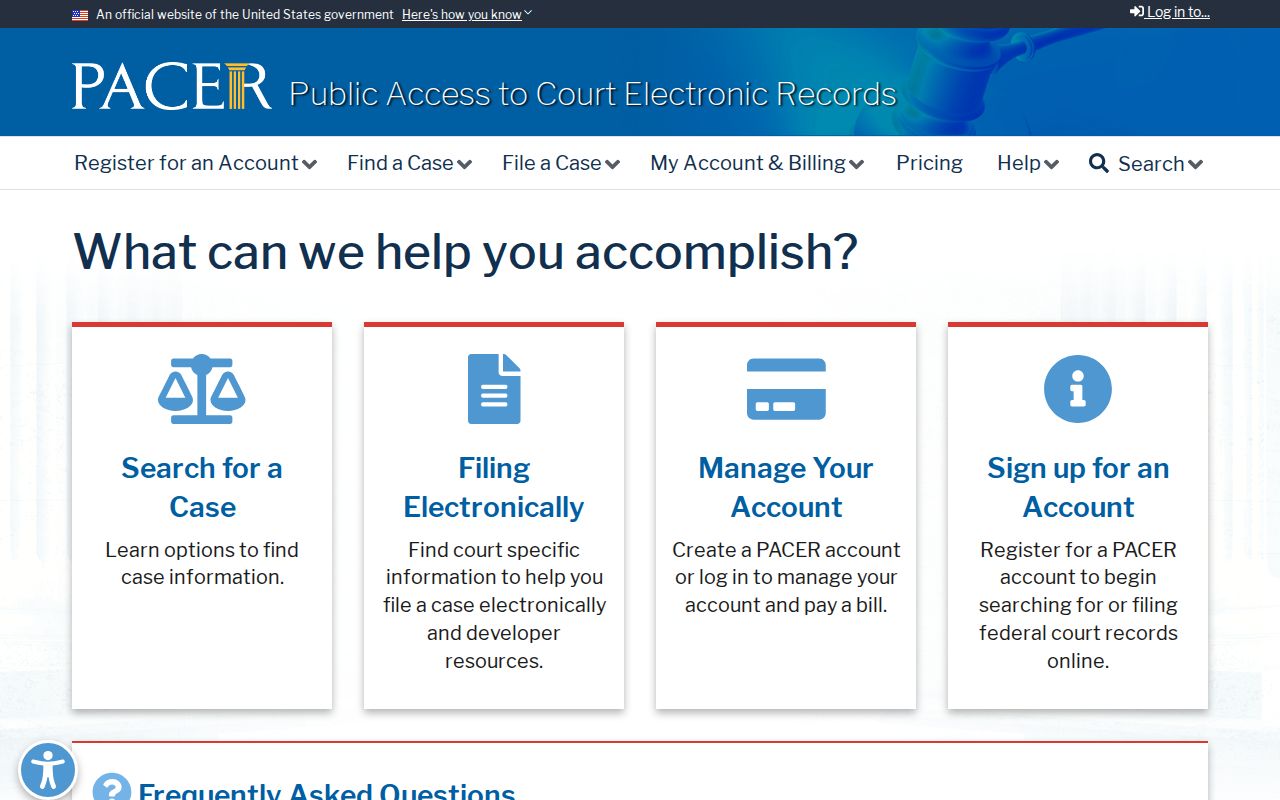
PACER does not replace either Montmorency trial-court search and may charge judiciary-set document fees.
Montmorency Court Technology and Access
Visitors who need help with court technology can call 989-785-8068. An accessibility request uses the Michigan court ADA form and local follow-up at 989-785-8022. These channels can help a person reach the court process, but they do not alter whether a specific record is public. Confirm the proper counter and document before making the trip to the county complex.
Local courtroom rules are strict. Phones must remain silent and cannot be used in court or hearing rooms. Weapons, food, drinks, gum, tobacco, newspapers, and electronic gear without approval are barred from courtrooms. Proceedings are recorded, so visitors must stay quiet and use the microphone-equipped podium or counsel table when directed. The official pages do not state that public lockers, transit, or a particular screening setup exists, so plan only around the rules the court actually publishes.