
Atlanta Criminal History Checks
An Atlanta search starts by matching the question to the record keeper. The Montmorency County Sheriff holds Atlanta reports it created. Michigan State Police controls its own Atlanta incident and traffic files. The 88th District Court keeps Atlanta misdemeanor cases and the early steps in felony cases, while the 26th Circuit Court keeps Atlanta felony matters after bindover. “Bindover” is the transfer of a felony from District Court to Circuit Court after the preliminary stage. ICHAT provides a filtered statewide name-and-date-of-birth result, not a complete Atlanta file.
- Identify the agency, event date, location, and any report or case number.
- Ask the sheriff or MSP for the agency report through its own records process.
- Search MiCOURT in both Montmorency courts when the case level is unclear.
- Follow the Alpena County channel for current detention after an Atlanta arrest.
- Use ICHAT for qualifying statewide public history, then compare it with the court file.
No one Atlanta source proves identity or supplies every event. A same-name ICHAT match needs careful review, while an Atlanta online docket remains an informational copy. The originating office controls its official record.
Atlanta Records Without City Government
The 2020 Census counted 720 people in Atlanta, but Atlanta’s importance comes from its county-seat role, not incorporation. Atlanta lies in Briley Township. The Atlanta community has no mayoral records office, Atlanta police records bureau, or city criminal docket. Searching for those Atlanta offices leads nowhere and can hide the useful route.
Atlanta does contain the county’s main justice offices. Atlanta court and clerk functions sit at 12265 M-32, and Sheriff Records is west on the same road at 11045 M-32 West. The Atlanta split is practical. Ask the sheriff for its Atlanta incident report, but ask the proper clerk for a charging document, register of actions, judgment, sentence, or certified court copy. The broader Montmorency County criminal-history overview explains how those Atlanta record types differ.
Records at the Atlanta Police Department
There is no Atlanta Police Department. Atlanta is an unincorporated CDP, so Atlanta law enforcement generally comes from the Montmorency County Sheriff or Michigan State Police. Michigan DNR officers may also create Atlanta records tied to conservation, snowmobile, or ORV enforcement. The agency named on the Atlanta citation, report receipt, or court complaint is the best clue to custody.
For a sheriff-created Atlanta record, use the official sheriff FOIA channel and send the Atlanta request to ATTN: Records Department, 11045 M-32 W, Atlanta, MI 49709. The main number is 989-785-4238. An Atlanta request may be dropped off or faxed to 989-785-4471. Fees depend on the Atlanta record, and the sheriff does not publish a flat copy schedule. Describe the Atlanta event by date, precise place, report number, involved names, and the specific items sought. Ask for an estimate before ordering a large file.
Montmorency Sheriff Records
11045 M-32 W
Atlanta, MI 49709
989-785-4238
FOIA fax: 989-785-4471
Atlanta Record Counters on M-32
Two Atlanta counters serve different Atlanta record needs. The Atlanta county building at 12265 M-32 houses the County Clerk and the 88th District Court. Published Atlanta county hours are 8:30 a.m. to 4:30 p.m. on weekdays except posted holidays, though court hours can differ. Atlanta District Court may be reached at 989-785-8035. The County Clerk’s Atlanta circuit-record line is 989-785-8022, and the county main number is 989-785-8000.
The Atlanta sheriff’s counter is at a separate address west on M-32. Call first when the needed Atlanta item may be a report, fingerprint service, or custody-routing fact. Call the Atlanta court when the goal is an official case record. This simple Atlanta split avoids filing a FOIA request for a certified judgment that only the court can issue.
The sheriff’s court information source shows the local courthouse guidance used for this routing.
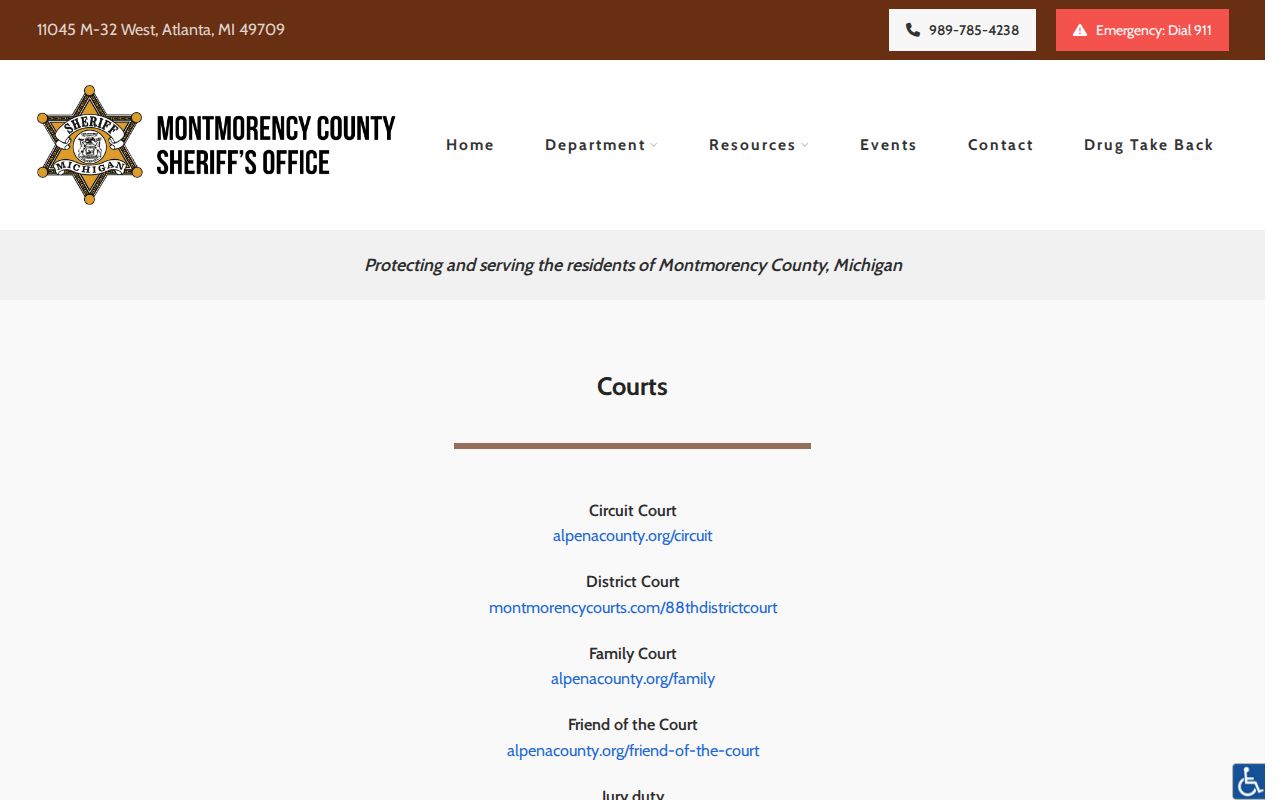
The published court guidance also helps visitors prepare for the rules inside Atlanta’s county complex.
Booking and Arrest Records in Atlanta
An Atlanta arrest may produce three separate Atlanta files. The Atlanta arresting agency writes the incident or arrest report. The designated Atlanta holding route creates intake and custody data. The Montmorency courts create the Atlanta complaint, bond order, hearings, and final disposition if charges are filed. The initial Atlanta arrest offense may change when the prosecutor reviews the referral.
Montmorency County does not operate a public county jail or Atlanta booking roster. The sheriff’s official jail routing page directs Atlanta detainees to the Alpena County Correctional Facility. Call the Montmorency Sheriff first to confirm who handled the Atlanta event and where the person went. Use the official Alpena Sheriff channel for present Atlanta custody, visitation, calls, and release details. Search the 88th District Court for an Atlanta complaint or arraignment. For a deeper look at that chain, the county’s arrest search resource covers the Atlanta report, booking, and court paths.
Note: An arrest records probable cause at one stage; it does not prove guilt or predict the final charge.
Atlanta Fingerprint Record Appointments
The sheriff offers a local fingerprint channel at 11045 M-32 West. Appointments are required through 989-785-4238, option 2. This service is useful when an official process calls for fingerprints or when a person follows Michigan’s set-aside procedure. The type and purpose of the print determine the applicable service and price, so confirm the current requirement before appearing.
The official Atlanta fingerprinting page is the source for appointment instructions and the current fee list.
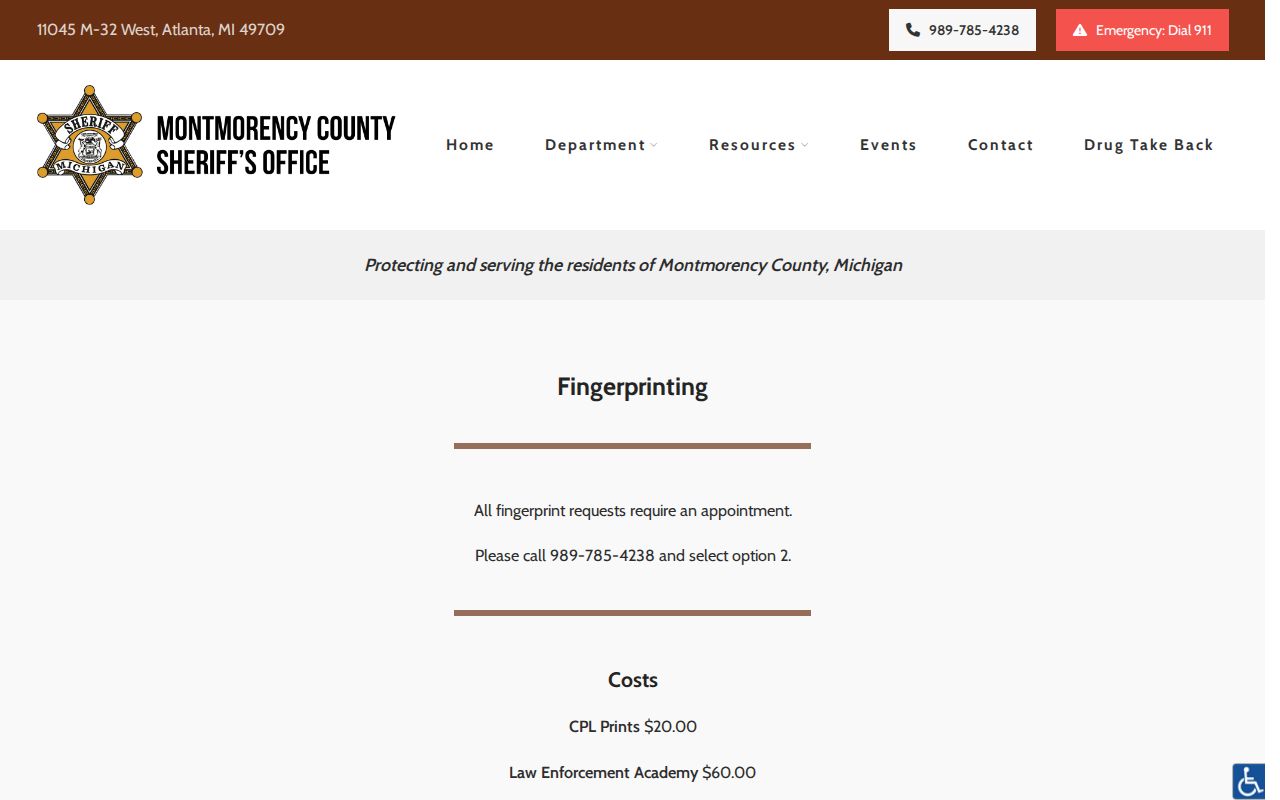
The Atlanta option does not turn a fingerprint card into a public search. The requesting agency decides where Atlanta prints go and what product is returned.
The Atlanta Municipal Court File
Atlanta has no municipal court file because Atlanta has no municipal court. An Atlanta misdemeanor or felony starts in Montmorency County’s 88th District Court. An Atlanta misdemeanor remains there through disposition. An Atlanta felony begins there for arraignment, probable-cause work, and preliminary examination, then moves to the 26th Circuit Court after bindover. Search both Atlanta courts when a felony has advanced or when one name appears under two case numbers.
| Court Name | 88th District Court and 26th Circuit Court, Montmorency County |
|---|---|
| Case Types Heard | District handles misdemeanors and early felony stages; Circuit handles felonies after bindover |
| Case Lookup Channel | MiCOURT, followed by the court clerk for the official file |
| What the Docket Shows | Case number, parties, public charges, events, status, and disposition data |
| Copies & Fees | Ask the court of record; local copy and certification charges were not published in the research |
MiCOURT can omit protected matters and older or filtered results. An absence from the web search is a reason to contact the clerk, not proof that a case never existed.
Atlanta Court Record Visit Rules
Atlanta’s courtrooms prohibit weapons, food, drinks, gum, tobacco, newspapers, and electronic equipment that has not been approved. Phones must be silent and cannot be used in court or hearing rooms. Quiet, discreet use is permitted elsewhere. Because proceedings are recorded electronically, speakers must use a microphone-equipped podium or counsel table and keep the room quiet.
The official courthouse rules page provides the source view for these Atlanta requirements.
Call Atlanta court technology help at 989-785-8068 or ADA follow-up at 989-785-8022 when Atlanta access support is needed. Atlanta parking, lockers, transit, and formal entry screening were not published, so verify them rather than assume.
Legal-help logistics also reflect Atlanta’s regional system. The Northeast Michigan Regional Defender Office has an Atlanta satellite at 12418 State Street. Research lists second and fourth Fridays from 9 a.m. to 3 p.m., with advance appointments. That schedule can change, and counsel eligibility comes through the court process, so confirm both points before travel.
How Atlanta Records Reach the County
Atlanta does not send local police files into the system because no Atlanta police agency exists. The actual flow begins with the sheriff, MSP, or DNR. If prosecution follows, the 88th District Court opens the first Montmorency case. A bound-over felony continues in Circuit Court. Courts and agencies report qualifying information to the Michigan State Police Criminal Justice Information Center.
Record flow: Sheriff, MSP, or DNR › Montmorency County Courts › Michigan State Police CJIC
ICHAT is CJIC’s public name-check product. It can show qualifying Michigan felonies and serious misdemeanors, but it omits warrants, suppressed records, juvenile matters, local misdemeanors, traffic, federal, tribal, out-of-state records, and other excluded data. A dismissal may be clear in the court file even when a repository result is absent or slow to update. Compare sources during a review of your own record.
Atlanta Corrections Records Are Separate
OTIS is the Michigan Department of Corrections tool for qualifying prisoners, parolees, probationers, and some people discharged from supervision within its stated window. It is not an Atlanta or Montmorency jail roster. It excludes county-jail-only custody, unsentenced arrestees, and several other categories. A missing OTIS result cannot establish that a person was never arrested or jailed.
The official OTIS source explains those coverage limits.
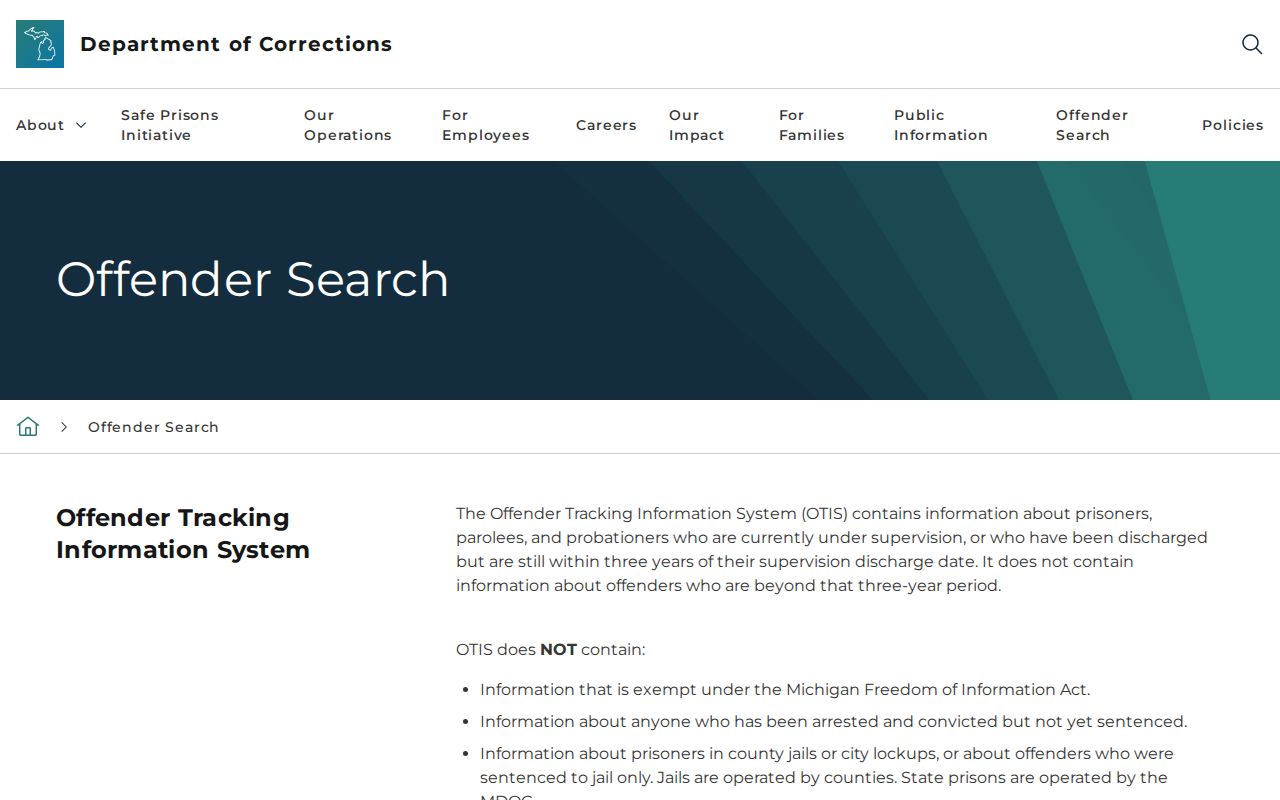
For probation or parole context, use the MDOC supervision source as a separate official layer.
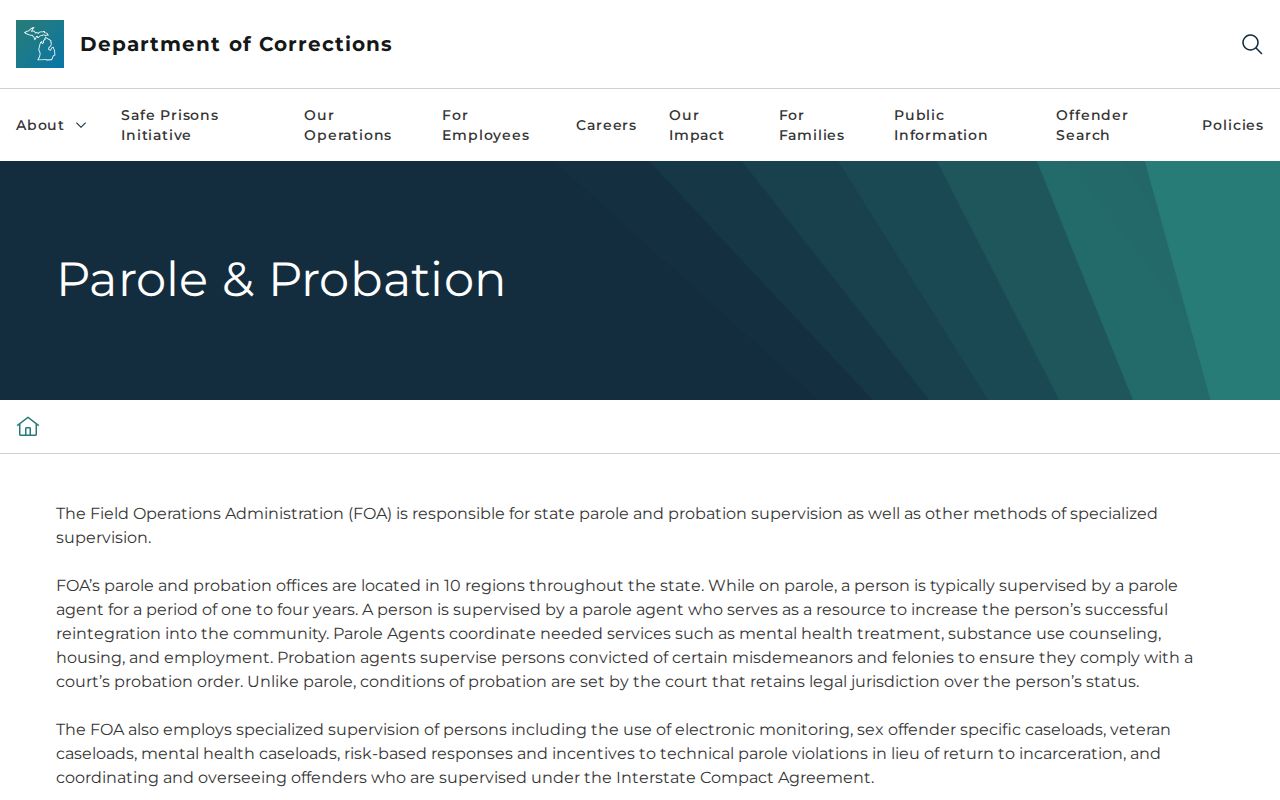
Local District Court probation can still fall outside the OTIS view, so the sentencing court remains part of a careful status check.
Atlanta Federal Criminal Record Boundaries
County and Michigan searches do not cover federal court files. Federal cases arising in this part of Michigan route through the U.S. District Court for the Eastern District of Michigan and PACER. Federal custody also has its own Bureau of Prisons locator. These channels should be used only when the question truly concerns a federal case or sentence.
The official federal inmate locator supplied the federal-custody image assigned to Atlanta.
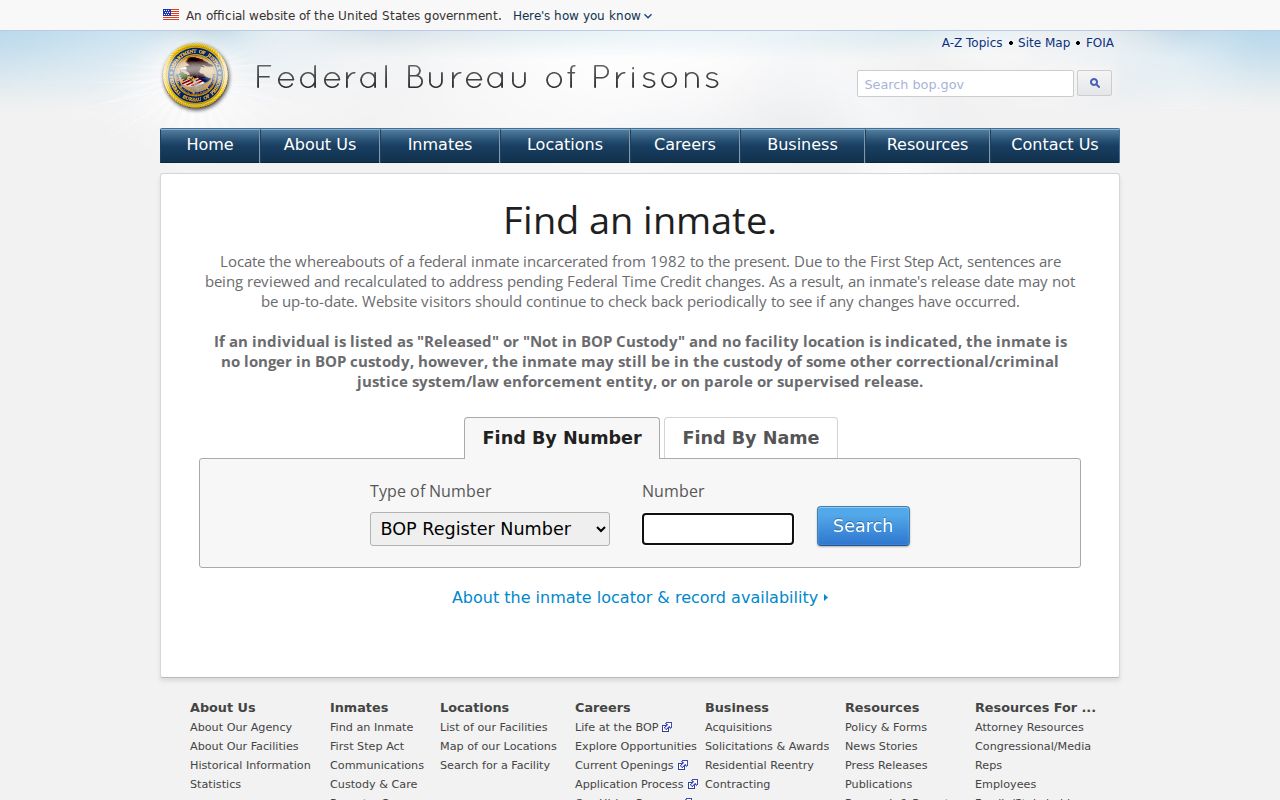
A federal locator result is not an Atlanta arrest report or Montmorency court record. Keep the jurisdictions separate.
Atlanta Record Access Rules
Michigan FOIA governs requests to public bodies, but it does not make every sheriff record open. A written request generally receives a response within five business days, and the agency may use the statutory extension. That deadline concerns the response, not guaranteed production. The reply may grant, deny, partly grant, seek clarification or a deposit, or extend the response period. Active-investigation facts, confidential sources, private details, juvenile information, victim information, medical data, and safety-sensitive material may be withheld or redacted.
Key Statutes:
MCL 15.231 states Michigan’s public policy favoring access to information about government affairs.
MCL 15.235 sets the general five-business-day response framework and extension process.
MCL 15.243 authorizes specified privacy and law-enforcement exemptions.
MCL 28.242 directs MSP to collect criminal-history and biometric information as provided by law.
Narrow requests reduce search time and cost. Ask for inspection or electronic copies when useful, and obtain certified case documents from the clerk rather than through sheriff FOIA.